



Why the potato
in Lazzate?
Because here it is not just any vegetable: it arrived with Alessandro Volta, it fed the village and it stayed. The festival exists to tell that story.
Welcome to the Sagra della Patata of Lazzate, now in its 21st edition. It is not only a tribute to the potato: it is a chance to rediscover the village's history and the farming traditions that shaped this community.
Alessandro Volta, known worldwide for inventing the electric battery, had a family house in Lazzate and came here on holiday. He was the one who brought potato growing to the village: a tuber that would change the diet and the farming economy of the whole region. Grateful, the people of Lazzate called him “the benevolent wizard”.
Every year the festival turns the village into a farmers' market, with local produce and, of course, the Lazzate potato on the table: traditional dishes cooked to old recipes, and a few new ones.
A small holiday lodge attached to some land of ours.
Alessandro Volta describes his house in Lazzate, 1796Volta and Lazzate, step by step
- From the 1600s The Stampa family, related to the Voltas, is among the main landowners in Lazzate.
- As a child Alessandro Volta comes to the village from an early age, above all in autumn, and keeps returning as an adult.
- 1777 He brings the first potatoes to Lazzate from Savoy, grows them in his own garden and persuades local farmers to grow them as food.local tradition
- 1796 In a letter he describes the house in Lazzate as a “small holiday lodge attached to some land of ours”.
- 1809 He inherits the house in the village from his brother Luigi: the one we still call Casa Volta.
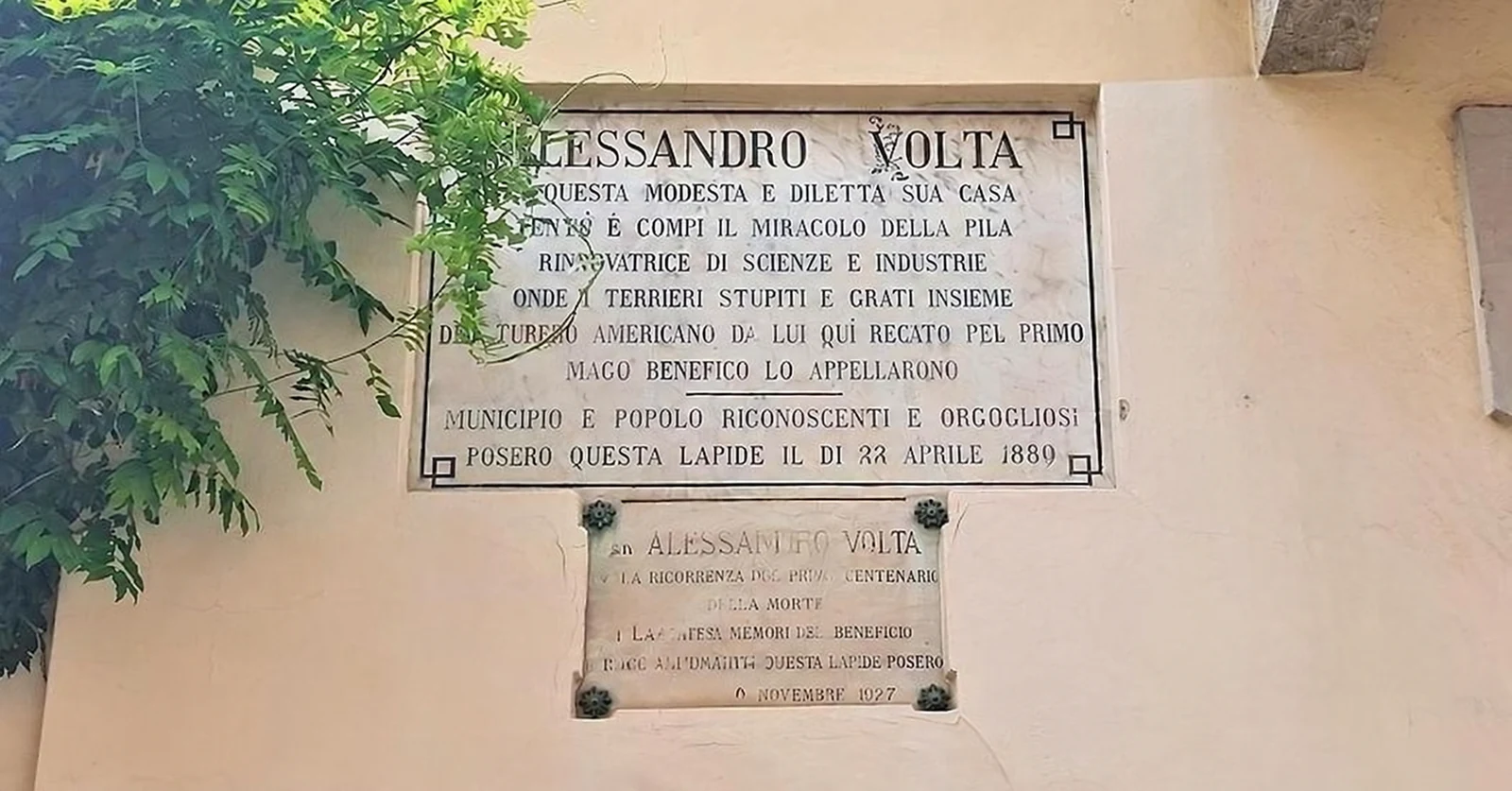
- 1889 · 1927 Lazzate dedicates two plaques to him on Casa Volta: the first on 22 April 1889, the second on 6 November 1927 for the centenary of his death.
- 1999 For the bicentenary of the battery, a bust is placed in piazzetta Cesarino Monti.
“They called him the benevolent wizard”
Onde i terrieri stupiti e grati insieme
del tubero americano da lui qui recato pel primo
mago benefico lo appellarono
This is not a saying handed down by word of mouth: it is carved in marble. The plaque was placed by the town council and the people on 22 April 1889, sixty-two years after Volta’s death. Below it a second tablet — by now worn away — was added on 6 November 1927 for the first centenary of his death.
The potato revolution
From the Andes to Lazzate: how a tuber people once distrusted became the food that fed Europe.
The potato comes from the Andes, where it had been grown for thousands of years. It reaches Europe only after 1492: the Spanish bring it home and from there it slowly spreads across the continent.
At first it was met with suspicion. It grew underground, it looked unfamiliar, and for decades it was little more than a botanical curiosity: gentlemen and botanists grew it in their gardens, for decoration.
The turning point comes in the eighteenth century, amid famine and war, when people discover that the despised tuber can keep a whole village alive. Those are the years when Volta brings it to Lazzate.

Why it changed everything
Plenty of complex carbohydrates: a plate of potatoes fed a family for very little.
Vitamin C, vitamin B6 and potassium, at a time when malnutrition was the norm.
Boiled, fried, as polenta, in gnocchi: it fits every regional cuisine in Europe.
Even in poor soil and difficult climates, and it keeps for a long time in a cellar.
Two men, the same prejudice
While Volta was persuading the farmers of Lazzate, in France a pharmacist was fighting the same battle. The two countries were not talking to each other, but the enemy was the same: the belief that potatoes made you ill.
A military pharmacist, he discovered the potato as a prisoner in Prussia during the Seven Years' War: he noticed that fellow captives fed on potatoes stayed healthy. In France, though, growing it had been banned since 1748, accused of causing leprosy.
To overcome mistrust he used cunning: he had a potato field guarded by gendarmes by day and left unwatched at night. The peasants, convinced something precious was there, went and stole them. And at court he brought Louis XVI a bouquet of potato flowers.
The same prejudice, the same years. Volta had no gendarmes: he had a garden and farmers to persuade. He started experimental plots on his land at Lazzate and Camnago, and set about showing in person that the tuber was good to eat.
He was not well received even at home, and academia did not take him seriously: the battery yes, potatoes no. Lazzate understood, and still remembers him as the “benevolent wizard”, as the plaque on his house puts it.
From history to the plate
The best part is that at the festival you can eat this story. Two dishes on our menu tell all of it: one comes from France, the other from the kitchens of Lazzate.
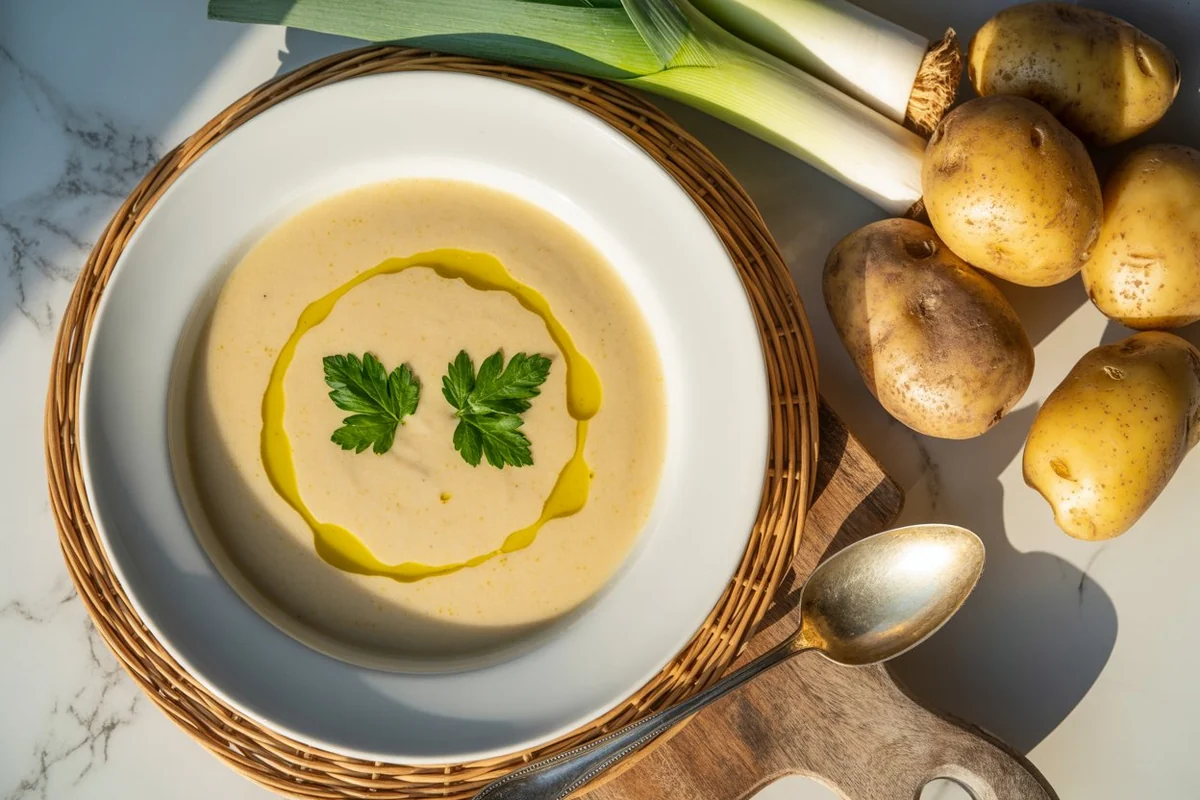
Parmentier
soup
Here at the festival you taste a piece of the history of the potato — and of humankind.
It looks like a simple potato and leek soup. It is the dish that carries the name of Antoine-Augustin Parmentier, the pharmacist who — in the very years Volta was at work here — convinced France that the potato was good to eat. Two men, two countries, the same battle against the same prejudice: and out of that battle came the food that took hunger out of Europe.
That is why this dish means more in Lazzate than anywhere else: you eat it two hundred metres from Volta’s house, in the village that won that battle first. One spoonful of hot soup, and the eighteenth century arrives at your table.
Paris, a winter evening. Two men who had never met find themselves at the same table. One is a French military pharmacist who has spent his life convincing his country that potatoes do not give you leprosy. The other is a Lombard professor who has come to France to show off his inventions, and who, in the village where he spends his summers, is fighting exactly the same battle on a smaller scale.
The story goes that Parmentier had him taste a potato and leek soup, and that Volta replied that on his land at Lazzate the farmers still fed that tuber to the pigs. The story goes that they talked late into the night, and that in the end they agreed on one thing only: that prejudice is not beaten with books, it is beaten at the table.
From then on — says the legend — the Frenchman carried on with his guarded fields and his banquets, and the Lombard went back to Lazzate to plant potatoes in his own garden. Each won his own battle, at home.
How much is true. The two really were contemporaries and the dates would allow it: Volta was in France on his journey of 1781-82 and returned to Paris in 1801, when Parmentier was alive (he died in 1813). But no document records that evening: Parmentier’s ideas reached Italy by way of books, not in person. It remains a good story — and at the festival we like to think it went that way, as we serve the soup that carries his name.
- 2 kg potatoes
- 100 g butter
- 3 or 4 cloves of garlic
- salt
- red version: tomato paste
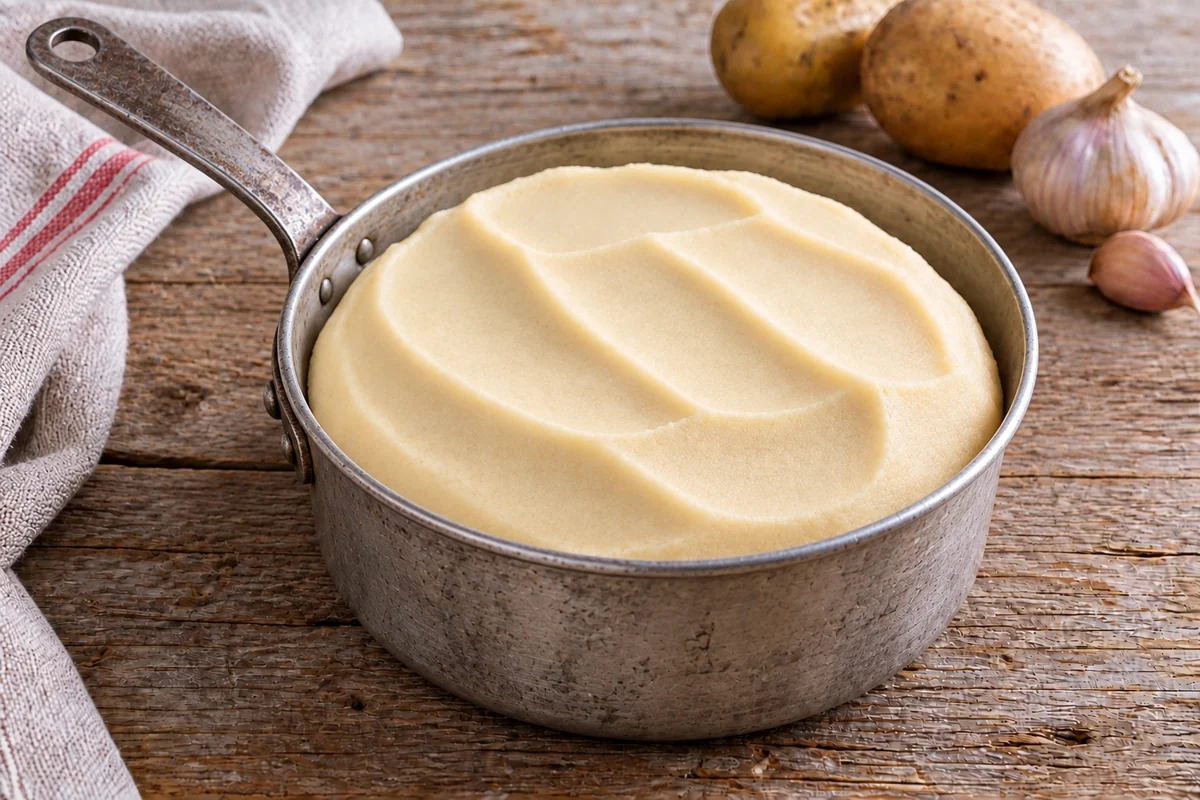
Boil the peeled potatoes in plenty of water. When cooked, drain them keeping one glass of the cooking water. Crush them with a fork, working in the water you kept. Salt. In a separate pan, brown the butter with the garlic cloves. For the red version, dissolve the tomato paste in the cooking water and stir it into the mixture. Once it is soft but not runny, pour the garlic butter over. Serve hot.
From the 2021 ecological calendar of the Comune di Lazzate: “a recipe of our Lazzate. Among the many versions each family has, we had to pick one”.
Pulenta de
pomm de tera
Potatoes, butter, garlic, salt. Four ingredients: everything there was.
It is the most Lazzate dish there is, and it is a poor man’s dish. No meat, no fish, no spices: you boil the potatoes, crush them with a fork, brown butter with garlic and pour it over. The name says it all — “polenta” because it took the place of maize polenta when maize was short or too dear.
Here you see why the potato was queen of the poor man’s table: it grew where wheat would not, it kept through the cold months, it filled you up. And those who had nothing else made the most of it with whatever was in the house — a knob of butter, a clove of garlic, and in families who could afford it a spoonful of tomato paste, the red version.
At the festival you will find it every evening, as a side dish. It is not the dish that impresses: it is the one the people of Lazzate recognise.
And they are not the only ones: two more dishes on the menu come from this same story.
The dessert created by chef Daniele Scanziani for Lazzate: potato candied with honey from local hives, mulberries and walnuts. The mould it rises in is shaped like the voltaic pile. You end dinner holding, quite literally, Volta's invention.
The story goes that Volta, a good eater, tried mixing potatoes into his pasta dough and found it came out lighter. From there, legend says, came modern potato gnocchi. Taken for what it is — a good story — the fact remains that Lazzate has always eaten gnocchi.legend
Between the eighteenth and nineteenth centuries the potato helped the European population grow: it improved the rural diet and cut deaths from malnutrition. Just how indispensable it had become was learnt the hard way in 1845, when a crop disease destroyed the Irish harvests and caused the Great Famine.
That is why Lazzate celebrates the potato. Not for the tuber itself, but for what it meant: a village that eats, a farmer who gets through the winter, and a scientist who, instead of keeping his discovery, gave it to his neighbours.